2025
Talk Excerpts
November 7th, 2025
- 12:45 pm: Welcome & Opening Remarks
- 1:00 pm to 1:45 pm | Through many lenses: community-based science in Alaska | Michelle Johannsen
Recommended reading:
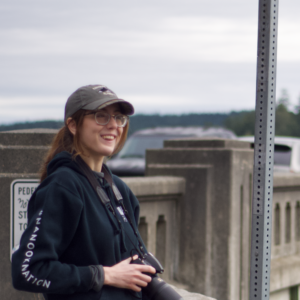
- 2:00 pm to 2:45 pm | Killer whales and killer contaminants: researching toxic pollution in the ocean’s top predator | Chloe Kotik
Killer whales are top predators throughout our oceans, but even these powerful cetaceans face hidden challenges. One major threat to killer whale health comes from contaminants: polluting chemicals from human products that make their way into the ocean and its inhabitants. Join Chloe Kotik for a fascinating look into contaminant cycling, the impacts of pollution on killer whales in Alaska and beyond, and the research that helps us protect these incredible animals and the ecosystems around them.
Recommended reading:
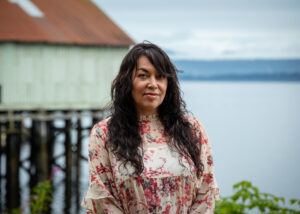
- 3:00pm to 3:45pm | Restoration & Healing: past, present, and future for Keex | Dawn Khaaxwáan Jackson
Recommended reading:
November 8th, 2025
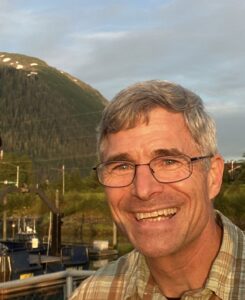
- 1:00 pm to 1:45 pm | Lose the Loop: A 25-year journey of pinniped entanglement research, prevention, response, and global collaboration | Kim Raum-Suryan
Entanglement in marine debris and fishing gear is a global problem affecting many different marine species, including pinnipeds (seals and sea lions). Join Kim Raum-Suryan as we take a journey to learn how pinniped entanglement research in Alaska led to efforts to prevent entanglements through the formation of the global Pinniped Entanglement Group, and finally to our ability to successfully respond to and disentangle Steller sea lions. “Lose the Loop!” – learn how you too can help prevent entanglements.
Recommended reading:
-
- Entanglement of Steller Sea Lions in Marine Debris and Fishing Gear on the Central Oregon Coast from 2005–2009
- The First Satellite Flipper Tag Deployments on Steller Sea Lions Allow Tracking Beyond the Annual Molt
- Entanglement of Steller sea lions (Eumetopias jubatus) in marine debris: Identifying causes and finding solutions
- Pinniped Entanglement Response Best Practices
- 2:00 pm to 2:45 pm | Ways of Knowing: Community Connections with Sea Otters and Abalone | Taylor White
What happens when sea otters return to a coastline—and how does that affect people who rely on shellfish? This talk shares how knowledge from local experts and Indigenous Knowledge bearers, combined with data from population surveys, is helping to better understand changes in pinto abalone populations in Southeast Alaska. Through interviews, mapping, and data analysis, researchers are learning how sea otter recovery is affecting subsistence harvest and local marine ecosystems in the places that matter most to harvesters.
- 3:00pm to 3:45pm | Reducing Seabird Bycatch: An Alaskan Success Story | Robert Suryan
We caught one of these, is that a problem? How a Short-tailed Albatross caught in Alaska two decades ago led to cooperative research with commercial fisheries and paved the way to finding effective solutions for a global problem.
Recommended reading:
-
- Lessons from seabird conservation in Alaskan longline fisheries
- Distribution, Habitat Use, and Conservation of Albatrosses in Alaska
- Translocation and hand-rearing result in short-tailed albatrosses returning to breed in the Ogasawara Islands 80 years after extirpation
- Global political responsibility for the conservation of albatrosses and large petrels
November 9th, 2025
- 1:00pm to 1:45pm | Marine debris cleanup: A messy way to make meaningful connections | Kristina Tirman
Turns out, nothing brings people together like picking up someone else’s trash. From the sea surface to the sea floor to the most remote Arctic shores, marine debris is everywhere – threatening wildlife, ecosystems, and the communities that rely on them. But amid the mess, something unexpected happens: connections form. In Alaska and across the Arctic, Ocean Conservancy is partnering with local organizations and Tribes to address marine debris through coordinated cleanup efforts, creative backhaul solutions, data collection, and community outreach. In this session, hear from Ocean Conservancy’s Arctic Marine Debris Manager about the challenges of working in remote environments and how this messy work is forging partnerships, building community, and creating lasting change.
Recommended reading:
-
-
Assessing strategies for remote island beach cleanups: Lessons from the
Pacific and Alaska
-
- 2:00pm to 2:45pm | The science behind solutions: What we learn from large whale entanglement reports and response | Michelle Dutro
Every year in Alaska, whales become entangled in marine debris, fishing gear, and non-fishery related materials. Each of these interactions has a unique story to tell – about the entangling material involved, the people who worked to help, and what was learned along the way. Using recent case studies and footage from entanglement response efforts undertaken by trained and authorized responders, Michelle tells an immersive story that highlights the value of whale entanglement reporting and how communities can come together to develop solutions.
Recommended reading:
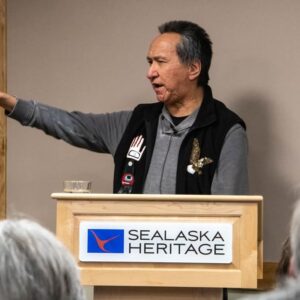
- 3:00pm to 3:45pm | Our knowledge entwined upon the land and sea | David Kanosh Yooḵis’kooḵéik
From time immemorial the Tlingit have lived upon these shores, passing their encyclopedic knowledge from one generation to the next. How did they preserve this knowledge through millennia? In this talk, David Kanosh will explain the importance of place and objects to not only preserve such knowledge but to pass it on to the next generation without corrupting it.
Recommended reading:
-
- Forward, written by David Kanosh, to “The Knowledge Gene” by Dr. Lynne Kelly
- “The Memory Code” by Dr Lynne Kelly. This book explains how indigenous cultures may have used Various mnemonic devices ranging from landscape down to handheld devices to memorize vast amounts of information.
- “Moonwalking With Einstein” by Joshua Foer. This book explores the author’s journey of learning mnemonic techniques. He explains the history of mnemonic techniques such as the memory palace from a western point of view. The author also explains myths and misconceptions about the nature of memory.
- “Memory Craft” by Dr Lynne Kelly. This standalone book can be used to learn how to use mnemonic techniques and make your own mnemonic devices to help you learn a wide variety of things.
- Kaagwaantaan leaders (Nels Lawson Sr, Charlie Daniels and William Kanosh Sr)hired me and entrusted me as their child and opposite to tell their story. | The entire Sitka Kaagwaantaan dance group also offered their approval and support.
- The same Kaagwaantaan leaders and the Sitka Kaagwaantaan dance group again hired me to tell the stories of their origin and migration.
- Sealaska Heritage Institute with their panel of anthropologist and linguists, hired me to recount stories of Raven.
- The Kaagwaantaan leaders of Sitka, Juneau and Douglas offered their support and approval as Sealaska Heritage Institute invited me to tell again their stories. | The various leaders offered their words in response to my narration of their stories.